Wednesday, June 22, 2011

Mowing and Rolling

Over the past several months we have been using some very interesting research that is being done by Dr. Rob Golembiewski at Oregon State University to manage our green speeds. For those of you that don't know Pasatiempo has some of the most severely sloping/undulated greens in the U.S. (original Alister MacKenzie design), and we are simply unable to manage the greens for daily play at anything faster than 10.5 on the Stimp meter and still maintain fair hole locations.


Dr. Golembiewski's research, which is a replication of similar trials that were done at Michigan State University on bentgrass, has shown that you can attain viable green speeds while mowing less often and at a slightly higher cutting height than what was previously thought. Currently we are mowing four days per week (at a cutting height of .120") and rolling seven days, while targeting the higher volume play days to mow and roll in combination. By keeping this schedule we've seen improved consistency from day-to-day with speeds ranging between 10' and 10.5' most days, and slightly higher on the days when we mow roll in combination. As the summer progresses, we also expect to see all of the obvious benefits of mowing at a higher cutting height (i.e. reduced damage from our local nematode, reduced disease and water use, better wear tolerance, improved density, etc...).

Saturday, June 18, 2011

#3 Cartpath Update

After a week of hard work by the maintenance staff, the cartpath on #3 will finally be open. Although the concrete was poured on Tuesday morning, it took several days for the concrete to "cure", and be ready for regular cart traffic. During the past week we had several of our guys out there making sure all of the shaping and sod work was done to our standards. The finished product looks great, and should improved the look and playability of the hole substantially

Thursday, June 9, 2011

Now...Let's Get This Straight


Existing cartpath and the Outline of where new cartpath will be located.
The big storm of March 19th not only took out the tree adjacent to the 3rd green, it significantly damaged the cartpath that circled around that massive tree.  Losing the tree was great from an architectural standpoint as the MacKenzie bunker complex is no longer hidden from view at the main entrance.  Another side benefit was the straightening of the new cartpath to go right through where the tree used to be.  This eliminates the awkward curvature of the previous cartpath and significantly increases the playability from the right side of the green complex.  Does it make the hole easier without the tree?  Not sure how a 235-yard uphill Par 3 is easy to begin with...

Project began on Tuesday June 7th with the pouring of concrete to occur on Monday June 16th.

Side view indicating just how close the old cartpath was to the bunker complex.


Saturday, May 21, 2011

90-Degrees...

That one object is situated perpendicular to one another.

10th Fairway showing undesirable cart traffic patterns

As turf professionals we have enough to worry about instead of being rules enforcers. It should not be that difficult to follow this age-old rule...to drive across the fairway, hit a shot, then drive back across to the cart path. The idea is to avoid driving up and down the fairways creating a dizzying effect due to an overload of tire tracks.  In short,  the "90-degree rule" minimizes the time a golf cart spends rolling over the grass, while still allowing convenience for golfers.  If anyone has had any luck in adequately controlling this issue please comment...

9th Fairway as viewed from the Clubhouse.  Cart traffic patterns clearly show disregard for the 90-degree rule.


Wednesday, May 18, 2011

Trees a Crowd

120-year-old Coastal Live Oak tree that split and quietly fell during the March 19th storm


How the wide open, right side approach shot appeared after the oak tree was lost

The first two of three oak trees added to the right side of the 14th fairway
During the March 19th storm, we lost seven trees total when the intense wind and rain storm ripped through the golf course.  Losing the massive 120-year-old coastal live oak along the 14th fairway was a tough.  Not only was that tree there before the golf course was ever built, but it is had impacted shots for many generations.  With that tree gone, the right side of the fairway had no protection.  MacKenzie intended shots to play from the left side and the angled green complex clearly identifies his intention.  Looking over several pictures from the 1930's, there were (3) trees that stood on the right side of the 14th fairway.  When the final soldier fell, it was time to bring back the design intent.  Three coastal live oak trees were transplanted in the same location as in the 1931 aerial photograph indicated.  


Third tree added to frame the right side and bring back the original design of the 14th hole

Sunday, May 15, 2011

Ghost of MacKenzie

A view from the 2nd fairway showing how the 3rd green complex looked in 1929

Photo taken two years ago with the massive Monterey Cypress adjacent to the right side of the 3rd green
Following the March 19th storm the cypress was severely damaged and was completely removed
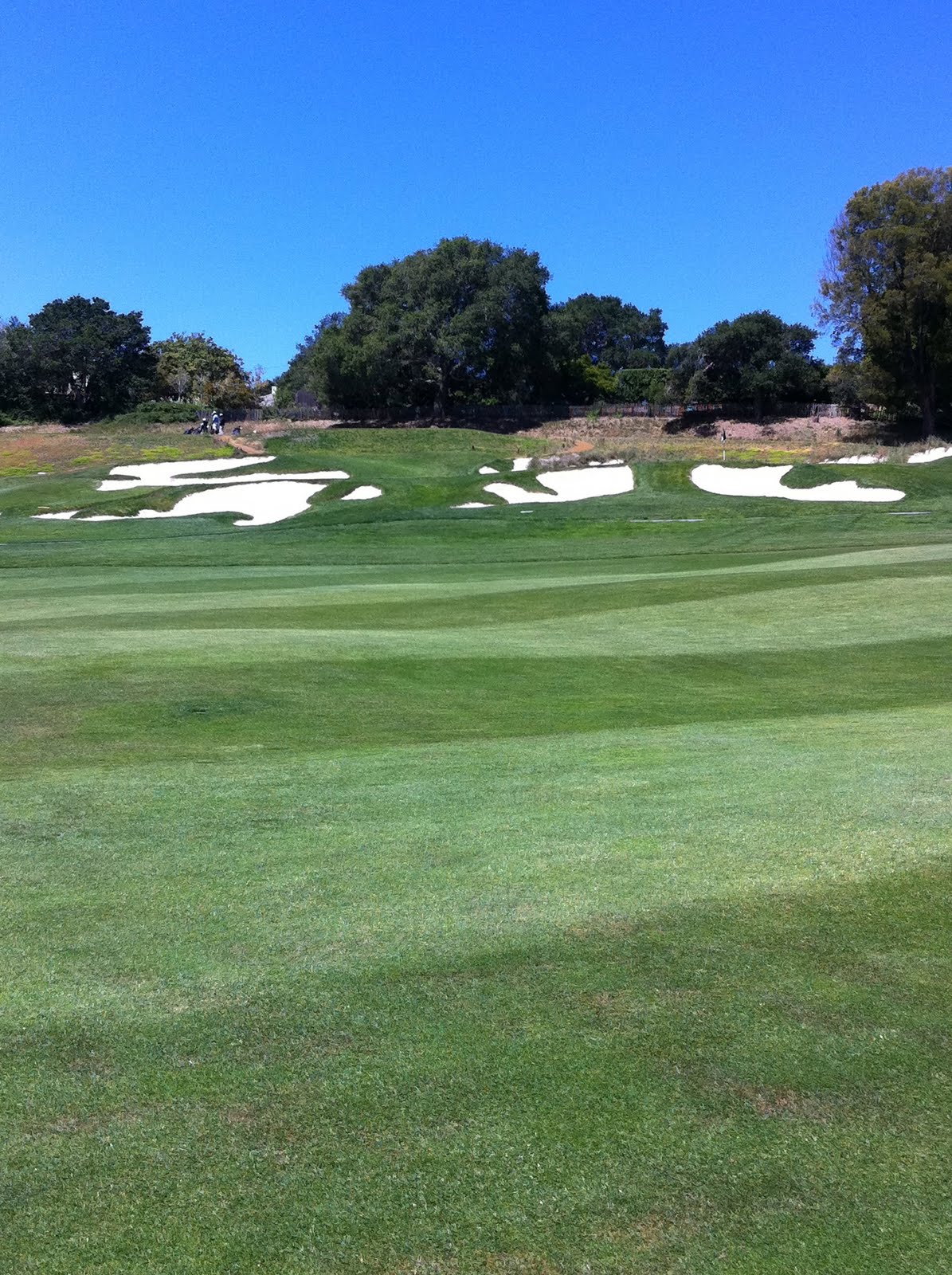
Turf managers know the problems trees can possess on the ability to grow healthy grass.  Architects know the fine balance between trees and turfgrass.  Dr. MacKenzie never intended a tree to be planted adjacent to the third green and felt that the severe green complex would be a fair enough test for the 235-yard uphill par 3.  The massive monterey cypress tree that grew on the right side of the green complex impacted shots for nearly 50-years and MacKenzie intended the right side to be a bail out area.  If you hit a shot that landed under that tree or had to hit through it, up to the third green, you almost guaranteed bogey.  The ghost of MacKenzie roared through on the night of March 19th when a massive wind storm took out the majority of the tree.  It was so severely damaged that the decision was made to remove the remaining stump and limbs.  Upon driving through the club entrance, one is now made aware of the famous MacKenzie bunkering as it is no longer hidden by the cypress tree.  From an architectural standpoint and a turfgrass manager standpoint, we all agree that this was a good thing.  The third hole is now more reminiscent of how the green complex looked in 1929.

My blog has moved!

You should be automatically redirected in 6 seconds. If not, visit
http://pasatiempomaintenance.com
and update your bookmarks.